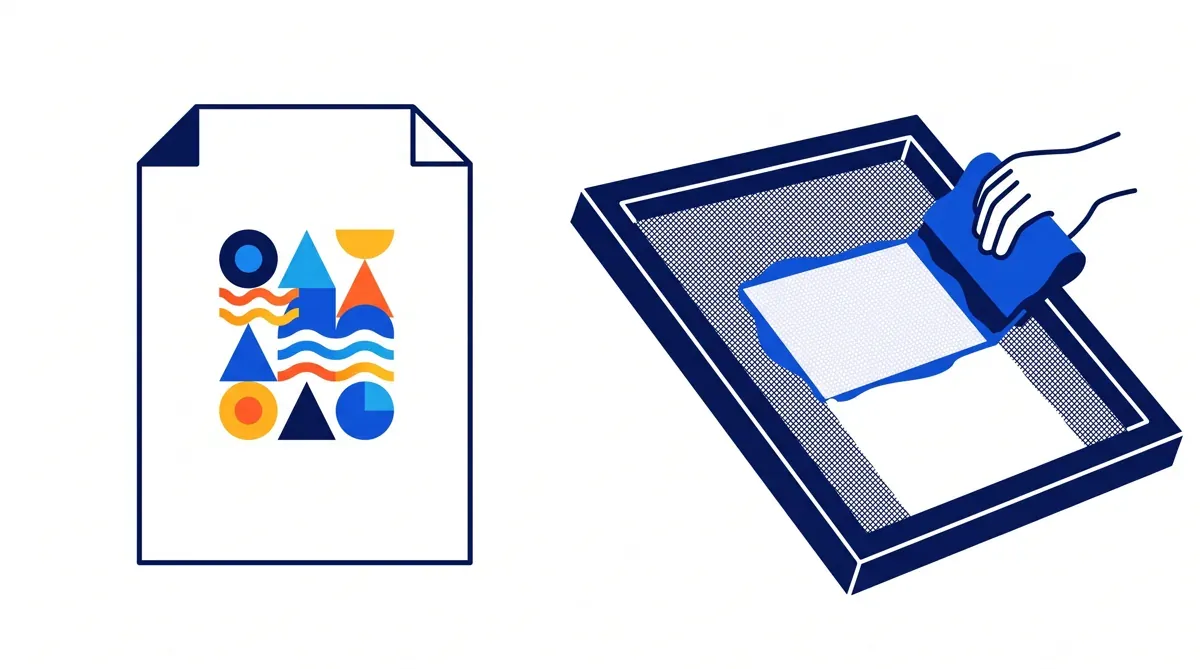
Screen printing has been the workhorse of garment decoration for decades, but DTF (Direct-to-Film) transfers have changed the math for small runs and full-color art. Here’s how they really compare so you can pick the right method for each job.
The quick answer
- Choose DTF for full-color designs, photos, small batches, mixed garment types, and fast turnaround with no minimums.
- Choose screen printing for very large runs of a simple, few-color design where the lowest per-unit cost matters most.
Side-by-side comparison
| DTF Transfers | Screen Printing | |
|---|---|---|
| Setup cost | None | Screens/films per color |
| Minimum order | Low (no big minimums) | Higher to be economical |
| Colors | Unlimited, full color | Cost rises per color |
| Photos & gradients | Excellent | Difficult |
| Fabric compatibility | Cotton, poly, blends, more | Best on cotton |
| Per-unit cost at high volume | Flat | Lowest |
| Turnaround | Fast (48 hours) | Longer with setup |
| Feel / hand | Light, flexible film | Soft on garment |
Where DTF wins
DTF skips screens entirely, so there’s no setup fee and no per-color charge. A 10-color photographic design costs the same to print as a one-color logo. That makes it ideal for small batches, on-demand orders, and designs with gradients or fine detail. Because the design lives on a film transfer, you can also press onto polyester, blends, canvas, bags, and hats — not just cotton tees.
Where screen printing wins
For thousands of the same simple design, screen printing’s per-unit price is hard to beat once the screens are made. The ink also sits in the fabric for a very soft hand on large solid prints. The trade-off is setup cost, higher minimums, and added cost for every extra color.
Bottom line
For most modern shops, brands, and hobbyists, DTF offers the flexibility screen printing can’t — full color, any fabric, no minimums, fast. Ready to try it? Start your order or browse transfer sizes & pricing. Still deciding? Compare DTF vs DTG and DTF vs sublimation.